
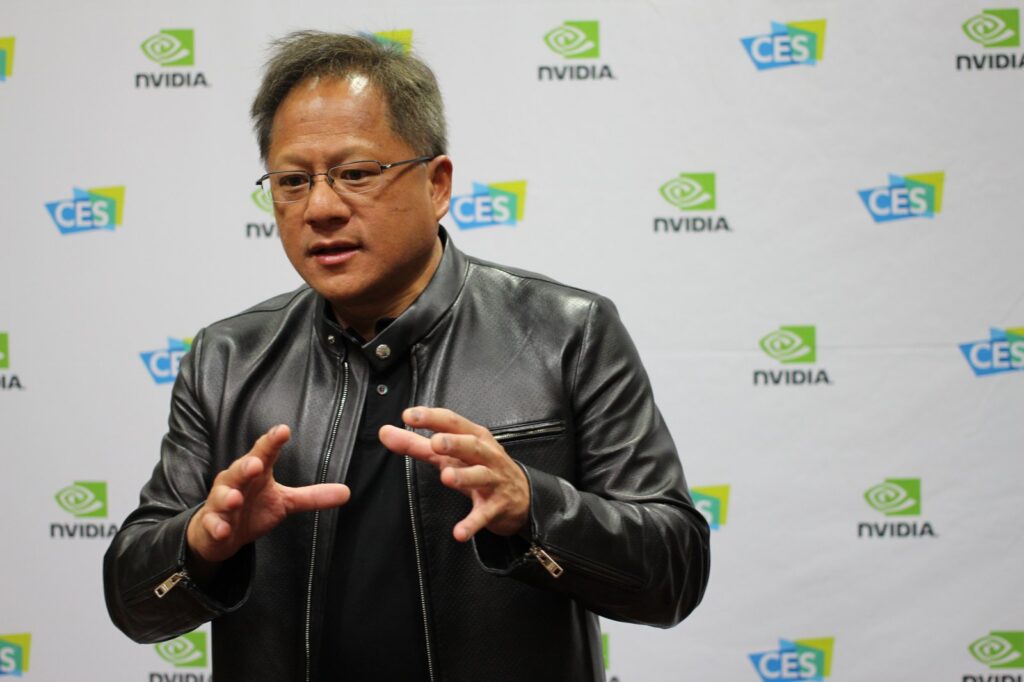
LONDON, October 19, 2026 — Jensen Huang is betting that Europe’s path to technological independence runs through open-weight AI. The Nvidia CEO argues that releasing model parameters to the public reduces vendor lock-in while ensuring that the massive hardware costs still flow to chipmakers like his own.
Huang made the pitch during a European tour that began in Paris, where he told an audience that the continent needs to get in the AI race. He is now in London, where he told Fortune that the industry should accept no cybersecurity incidents from AI. “I’m willing to accept no incidents of cybersecurity. We should not accept any of them,” he said. “We should do everything we can to avoid them.”
Zero Tolerance for AI Cyber Incidents
Huang’s stance puts him at odds with OpenAI’s Sam Altman, who recently suggested that some hacks and scams may be a necessary tradeoff for AI’s benefits. Altman warned of a coming tidal wave of cybersecurity problems from rival open-source models. Huang disagrees, telling Fortune that the incidents so far could have been avoided with stronger containment.
He compared the current risk to the early consumer internet, when clicking on a website could infect a PC with a virus. The fix then was for browsers to run websites in isolation. Huang says AI agents need the same treatment. They should be sealed inside a secure container where they cannot do damage beyond what they are allowed access to. He also dismissed warnings of existential risks from AI, stating the technology is completely in our control.
The Sovereignty Pitch: Open Weights as Europe’s Edge
The shift is clear: open-weight models are becoming Europe’s competitive edge. Huang has pitched open-source models as the best route for the region to catch up with the United States. According to Fortune, this strategy aligns with Nvidia’s commercial interests. Open-weight models lower costs for the companies building them, but the hardware spending still goes to the chipmaker.
Open weights allow users to host models themselves, reducing vendor lock-in regarding service providers. Sharad Chole, chief scientist and co-founder at Expedera, noted that publishing weights allows users to choose their own service provider or host the model independently. This flexibility is critical for European firms seeking to avoid dependency on a single US-based API provider. As of September 2026, larger open-weight models primarily come from outside the U.S., such as Europe or Asia.
Nvidia’s $2 Billion European Commitment
Words are paired with capital. Huang said Nvidia would announce $2 billion in new European investments within the next week. This adds to the $8 billion the chipmaker has already committed to the continent. The investment underscores the strategic importance of the region to Nvidia’s long-term growth.
Huang’s tour includes Berlin, where Nvidia’s GTC conference will be hosted later in the month. The event will likely serve as a stage for further announcements regarding the company’s European infrastructure plans. For Europe, the deal offers a chance to build its own AI ecosystem rather than relying on imported services. The trend underneath is a move toward localized control of AI infrastructure.
Mistral’s Large 4 and the Hardware Reality
Nvidia is a major backer of Mistral, a French open-weight developer. Mistral recently released its Large 4 model, which was trained on 4,000 Nvidia Grace Blackwell GPUs. This collaboration highlights the economic paradox at the heart of the open-weight movement. While the model weights are open, the compute required to train and run them is not.
Guillaume Boillet, vice president of strategic marketing at Arteris, explained that open-weight models make trained parameters downloadable, letting users run and adapt them on their own hardware. However, they are not necessarily open source, as training data and code may remain restricted. This distinction is vital for understanding the business model. Companies like Mistral can offer powerful tools without handing over the full recipe, while Nvidia sells the silicon needed to power them.
The Economic Paradox of Open Models
The trend underneath this strategy is a decoupling of software access from hardware dependency. Open-weight models lower costs for developers, but they ensure that hardware spending still goes to chipmakers like Nvidia. This creates a stable revenue stream for the chip industry even as software becomes more accessible.
As the industry moves toward trillion-parameter models, the demand for adaptable hardware-software platforms will grow. The winners will build systems that can handle rapidly changing workloads, rather than accelerators optimized for a single benchmark. Watch this space: the next phase of the AI race will be defined by who controls the hardware that runs the open models. For Europe, the bet is that sovereignty lies in owning both the model and the machine.
Sources
- What Is DeepSeek? Open-Weight AI Models Explained | Built In
- Why Open-Weight AI Matters
- Nvidia’s Jensen Huang wants ‘no incidents’ of AI cybersecurity, and says AI doomers ‘ought to stop working on’ the technology | Fortune
Photo: Maurizio Pesce (CC BY 2.0)




