
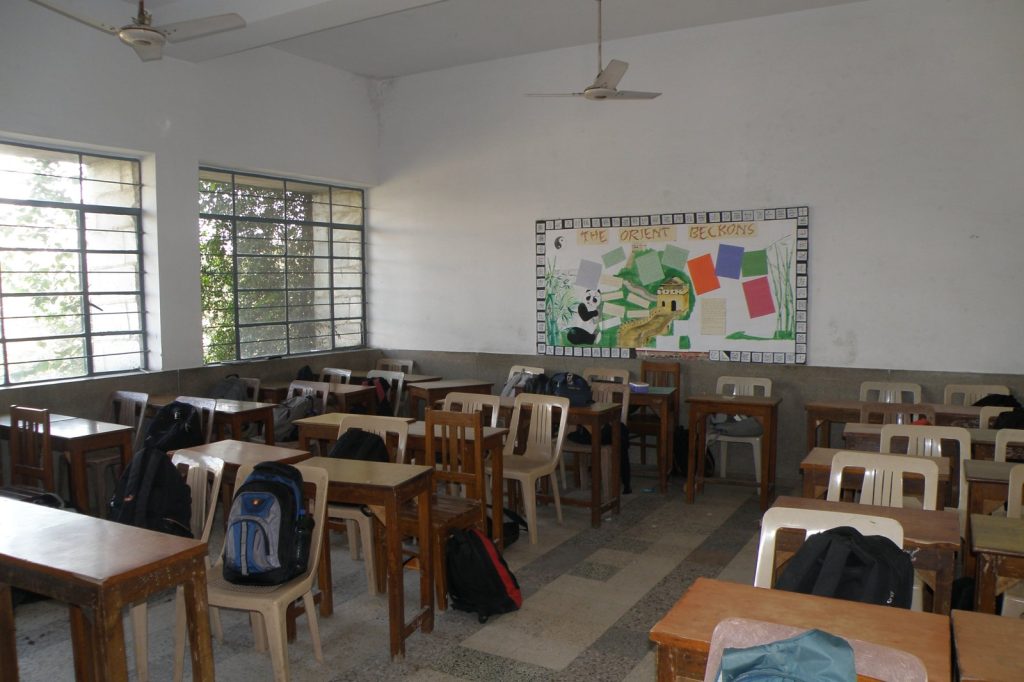
NEW DELHI — The school bell rings on two different Indias this June. One hears the whir of a smart board booting up, the quiet click of a personalized learning module loading on a tablet. The other hears the crack of dry plaster falling from a ceiling, the hum of a generator that might fail before lunch.
These are not separate news cycles. They are the same story, unfolding simultaneously under the same Ministry of Education mandate.
The government has formally integrated artificial intelligence into school curricula across the country through CBSE and NCERT. Students in grades 9 are now expected to engage with AI content. CBSE offers a 15-hour AI skill module from Class VI onward.
AI is an optional subject in Classes IX-XII. NCERT has placed AI content in Class XI Computer Science and Informatics Practices textbooks.
The policy is national. The infrastructure to deliver it is not. In India’s Tier-1 metro schools, the policy lands on prepared ground.
Automated learning modules, smart boards, and pilot partnerships with global tech firms for Large Language Models are already part of the daily routine. The new curriculum is an upgrade, a refinement, a natural next step. For students in those classrooms, AI is a tool they touch and use.
Cross the city limits. Enter rural India, Tier-3 towns, the vast stretch where most of the country’s children actually live.
The school reopening means a return to a different fight. Cracked plaster walls. Hardware sitting on shelves, covered in dust, never functional.
Electricity that comes and goes. Internet connectivity that is, in practical terms, absent.
The Ministry’s curriculum assumes a connected device. It assumes power. It assumes a teacher who has been trained on the material.
In rural schools, none of those things can be taken for granted. This is not a simple lag in adoption. It is a structural fracture running straight through the demographic dividend India counts on.
The country’s macroeconomic indicators tell a story of a digital renaissance. Stock markets climb.
Tech exports grow. Unicorn startups multiply. But the indicators do not show the dust on the non-functional hardware.
They do not measure the gap between a policy printed in Delhi and a classroom in a village where the internet has never worked. The consequence is blunt.
Two groups of children, same age, same grade, same national curriculum. One group learns to prompt an AI model. The other group cannot reliably charge a phone.
One group will graduate into an economy that demands digital fluency. The other will graduate into the same struggle for basic amenities that their parents faced. The Ministry has integrated AI into the syllabus.
It has not integrated electricity or connectivity into the rural school day. This is where the story is heading.
The gap does not close on its own. It widens. Each year of policy without infrastructure deepens the divide.
The children in metro schools move forward. The children in rural schools fall further behind.
The demographic dividend, the much-touted advantage of a young population, begins to look less like a windfall and more like a trap. A large, undereducated, digitally illiterate workforce is not a dividend. It is a liability.
The Ministry’s curriculum is real. The CBSE module exists. The NCERT textbooks are printed.
But a policy that lands only where the infrastructure already exists is not a solution. It is a mirror, reflecting back the inequality that was already there.
{“@context”: “https://schema.org”, “@type”: “NewsArticle”, “headline”: “New Delhi schools begin AI integration amid vast infrastructure disparities”, “description”: “NEW DELHI — The school bell rings on two different Indias this June. One hears the whir of a smart board booting up, the quiet…”, “datePublished”: “2026-06-18T08:30:00+00:00T09:30:00+00:00”, “author”: {“@type”: “Person”, “name”: “Henry Thomas”}, “publisher”: {“@type”: “Organization”, “name”: “InfoPulse Today”, “url”: “https://newsfeed.infopulsetoday.com/”}}




