
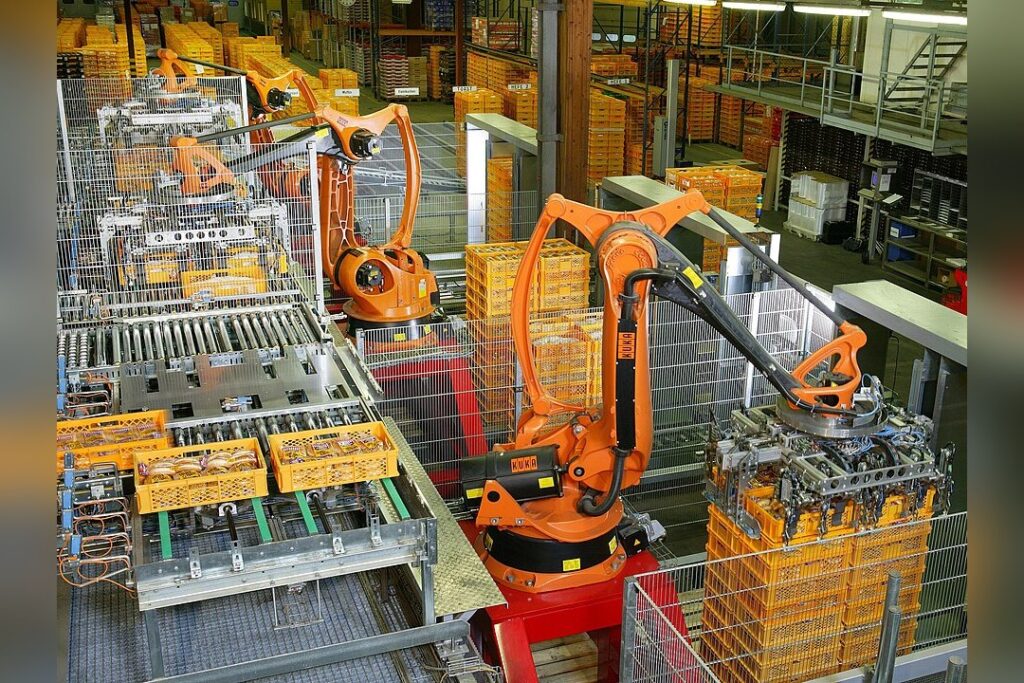
For years, the problem was obvious to anyone who worked on a factory floor. Robots could weld a car door or stack a pallet — over and over, exactly the same way. But ask one to pick up a slightly different part, or adapt to a changed layout, and it failed.
The industry called it the “impossible triangle.” Generalization, efficiency, reliability. You could have two, but never all three.
That is the bottleneck Youibot set out to break. The company, based in Hefei, Anhui Province, did not take a consumer AI model and try to shrink it down for factory work. That approach had already failed.
Consumer models are built for language and images, not for gripping a gearbox or navigating a dark warehouse aisle. So Youibot started from the other end.
They built FabriX directly inside industrial scenarios. The model grew out of real production lines, not a lab bench. The result was announced June 29.
FabriX, the company says, is the world’s first industrial embodied AI model ready for large-scale deployment. And it comes with a body: Xifeng, a humanoid robot designed from the ground up for factory work. Not a repurposed research platform.
A machine built to work. Xifeng arrives with basic motor skills already in place.
That is the low-shot transfer learning technology at work. Youibot’s engineers trained it on-site using just 50 datasets. Early results show a 90 percent task success rate.
The system then improves on its own through 24-hour cyclic training. The longer it runs, the better it gets.
No weekend shutdowns. No waiting for a programmer. This is not a theoretical advance.
Youibot announced the FabriX Ecosystem Partner Program at the same event. The target is blunt: empower 10,000 industrial workplaces. Equip existing production lines with self-perception, autonomous decision-making, and self-recovery.
That means a line that can notice a jam, decide how to fix it, and recover without a human stepping in. Youibot itself is a key industrial embodied intelligence enterprise brought in by Anhui Province and Hefei City.
Its headquarters and smart manufacturing base sit there. The government bet on this company early. The bet is now public.
The field of embodied intelligence has struggled to move beyond the lab. General models could not meet the high-precision, high-reliability demands of real production.
Youibot claims to have crossed that line. The company describes the old problem as an “impossible triangle” — generalization, efficiency, reliability — that blocked industrial applications. FabriX was not simplified from consumer AI.
It was grown directly out of industrial scenarios, building a dedicated technical foundation for complex operations. Factory managers may now have a decision to make. The robot is real.
The model is deployed. The 90 percent figure is early but encouraging.
And the system does not stay static. It iterates. That is the point.
Not a one-time installation, but a machine that learns as it works. Youibot is not promising a revolution in a press release.
It is promising 10,000 workplaces retrofitted with self-recovering lines. That is a specific, measurable goal. Whether the triangle is truly solved — whether generalization, efficiency, and reliability can coexist at scale — will be answered on factory floors, not in announcements.
{“@context”: “https://schema.org”, “@type”: “NewsArticle”, “headline”: “Anhui Firm’s New AI Model Aims to Solve Factory Robotics ‘Impossible Triangle’”, “description”: “For years, the problem was obvious to anyone who worked on a factory floor. Robots could weld a car door or stack a pallet —…”, “datePublished”: “2026-07-01T06:16:19+00:00T09:30:00+00:00”, “author”: {“@type”: “Person”, “name”: “Muhammad Asim”}, “publisher”: {“@type”: “Organization”, “name”: “InfoPulse Today”, “url”: “https://newsfeed.infopulsetoday.com/”}}




