
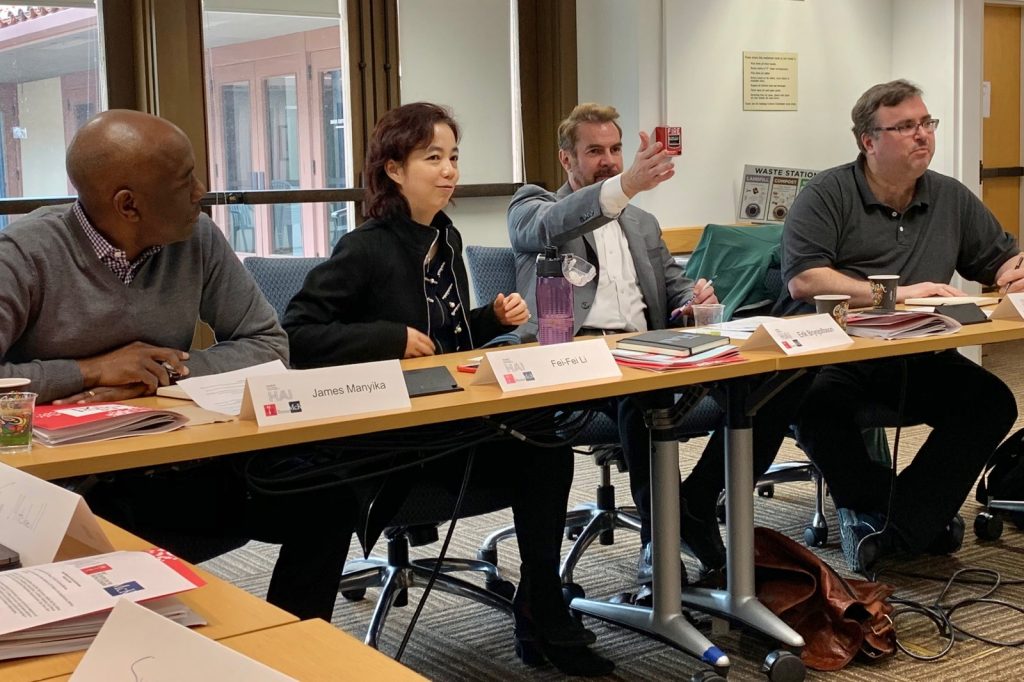
BEIJING, July 8 — A Chinese-American computer scientist who helped lay the technical foundation for today’s artificial intelligence boom has, in recent years, turned her focus to the ethical and human dimensions of the technology she helped advance. Fei-Fei Li, co-director of the Stanford Institute for Human-Centered AI (HAI), was born in Beijing in 1976 and moved to the United States at age 15.
Her trajectory from a teenage immigrant to a leading figure in computer science mirrors, in some ways, the arc of AI itself — from a niche academic pursuit to a force reshaping global industries. Li earned a bachelor’s degree in physics from Princeton University in 1999 and a Ph.D. in electrical engineering from the California Institute of Technology in 2005.
Her academic credentials are well-established, but it is her work beginning in 2009 that drew the attention of the broader tech world. That year, Li led the creation of ImageNet, a dataset containing over 14 million labeled images. According to published accounts, the scale of the dataset was unprecedented at the time.
It became a critical resource for training machine-learning models, and in 2012, it enabled a breakthrough in the ImageNet competition — a moment widely regarded as the beginning of the deep learning era. Her work has been cited more than 200,000 times, according to available records, placing her among the most influential researchers in the field.
From industry to advocacy
Li served as chief scientist of AI and machine learning at Google Cloud from 2017 to 2018. That stint in the corporate sector, officials familiar with her career have noted, gave her a firsthand view of how quickly AI was being deployed in commercial settings — and how unevenly its benefits were being distributed. In 2017, she co-founded AI4ALL, a nonprofit organization aimed at increasing inclusion and diversity in the artificial intelligence field.
The initiative focuses on bringing underrepresented groups into AI education and career pipelines. State and international reports have described AI4ALL as one of the more prominent efforts to address the demographic imbalances that have long characterized the tech industry.
Li has also been a vocal advocate for what she calls “human-centered AI” — a framework that prioritizes ethical considerations, transparency, and societal benefit alongside technical performance. Her role as co-director of Stanford HAI places her at the center of academic efforts to shape AI governance.
A personal narrative
In 2023, Li published a memoir titled “The Worlds I See: Curiosity, Exploration, and Discovery at the Dawn of AI.” The book, according to published summaries, weaves together her personal story — from her childhood in Beijing to her arrival in the United States — with the broader history of artificial intelligence. The account indicates that Li sees her own journey as emblematic of the kind of cross-cultural, interdisciplinary thinking that she believes is necessary for responsible AI development.
She has described the technology as being at a “dawn” — a period of immense possibility but also significant risk. For observers in Iran and across the broader Middle East, Li’s trajectory carries particular resonance.
The region has long grappled with a brain drain of its own scientists and engineers, many of whom have pursued careers in Western institutions. Li’s story — a Chinese-born scientist who rose to prominence in the United States — underscores the global nature of the AI talent pool and the challenges that countries face in retaining their own researchers.
What to watch next
Li continues to teach and research at Stanford University. Her work at HAI focuses on ensuring that AI development remains aligned with human values — a goal that, according to state and international reports, has gained urgency as governments around the world race to regulate the technology. The question of whether the AI industry will heed calls for greater inclusion and ethical oversight remains open.
Li’s own career suggests that the technical breakthroughs are only part of the story — the harder work, she has indicated, lies in deciding how those breakthroughs are used.
{“@context”: “https://schema.org”, “@type”: “NewsArticle”, “headline”: “Fei-Fei Li’s ImageNet Dataset Sparks AI Revolution in Medicine”, “description”: “BEIJING, July 8 — A Chinese-American computer scientist who helped lay the technical foundation for today’s artificial intelligence boom has, in recent years, turned her…”, “datePublished”: “2026-07-08T09:30:00+00:00”, “author”: {“@type”: “Person”, “name”: “Reza Karimi”}, “publisher”: {“@type”: “Organization”, “name”: “InfoPulse Today”, “url”: “https://newsfeed.infopulsetoday.com/”}}




