
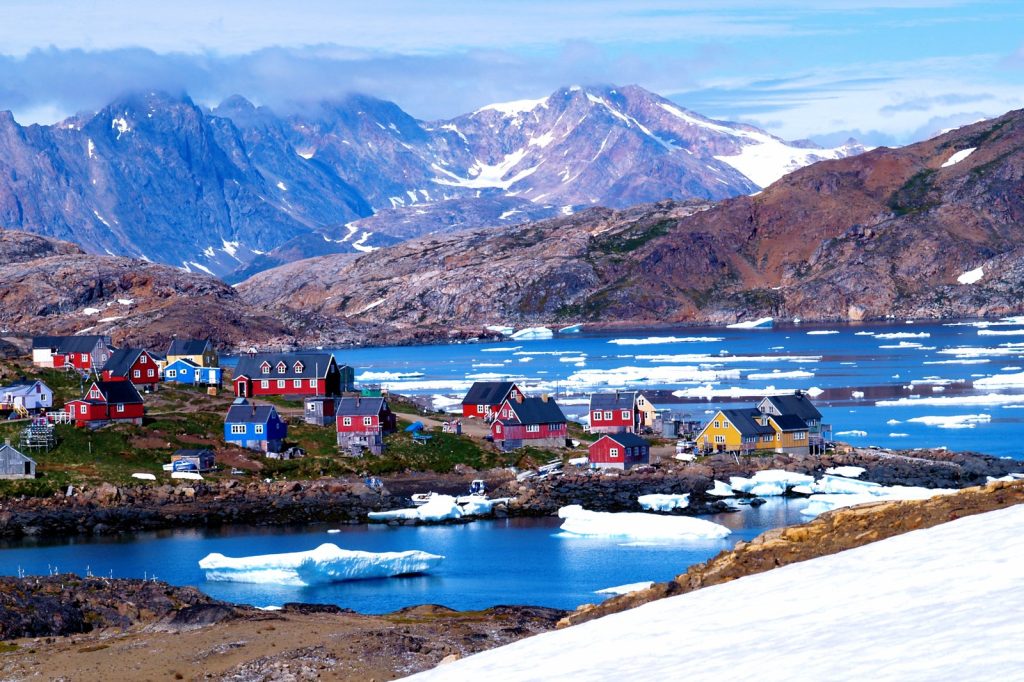
NUUK, September 19 — On the ground in Greenland, the island’s place in Washington’s thinking has rarely been more visible. The United States has moved to expand its military access to Greenland under a new permanent security arrangement, a step aimed at keeping adversaries out of a region that sits between North America and Europe. Secretary of State Marco Rubio said Greenland will remain within North America’s strategic defense area.
The arrangement does not change Greenland’s territorial status, and the announcement did not specify new bases or troop numbers.
Why Greenland Matters
The island’s strategic importance has grown for reasons that stack on top of one another. It lies between North America and Europe, sits close to emerging Arctic shipping routes, and holds significant reserves of rare earth minerals and other natural resources. The Arctic is warming at more than twice the global average, opening new sea routes such as the Northwest Passage and the Northern Sea Route.
Greenland also sits astride the Greenland-Iceland-UK Gap, a key maritime chokepoint for Russian naval access to the Atlantic. And it hosts the shortest great-circle routes between North America and Europe for aircraft and missiles.
A Territory of About 56,000
Greenland is an autonomous territory within the Kingdom of Denmark, with a population of about 56,000, predominantly Inuit. Its capital is Nuuk. The economy relies on fishing and Danish subsidies.
Residents describe an island weighing greater autonomy and economic development, including possible independence from Denmark. The US arrangement may affect those discussions.
Greenland holds some of the world’s largest untapped rare earth deposits, including at Kvanefjeld and Kringlerne, which are critical for electronics, renewable energy, and defense applications. China has sought to invest in Greenland’s mining sector, raising US security concerns. In 2021, Greenland’s government banned uranium mining, affecting some rare earth projects.
An Arctic Competition
The United States, Russia, and China are all expanding their Arctic military and economic activities. Russia has reopened Soviet-era Arctic bases and built new ones. China has increased its Arctic research and shipping presence, though it is not an Arctic state.
The US has sought to counter these moves through NATO and bilateral agreements. The US military presence in Greenland is part of NORAD and supports NATO’s Arctic strategy.
The strategic defense area of North America is defined by NORAD, a joint US-Canadian command. In 2019, President Trump proposed purchasing Greenland, a suggestion rejected by Danish and Greenlandic authorities. The Arctic Council, which includes the US, Russia, and Nordic states, is a key forum for Arctic cooperation, though it has been paused since 2022 due to Russia’s invasion of Ukraine.
By nightfall in Nuuk, what to watch next is whether the arrangement shifts Greenland’s own debate over autonomy — and whether the pause in Arctic Council cooperation holds.




