
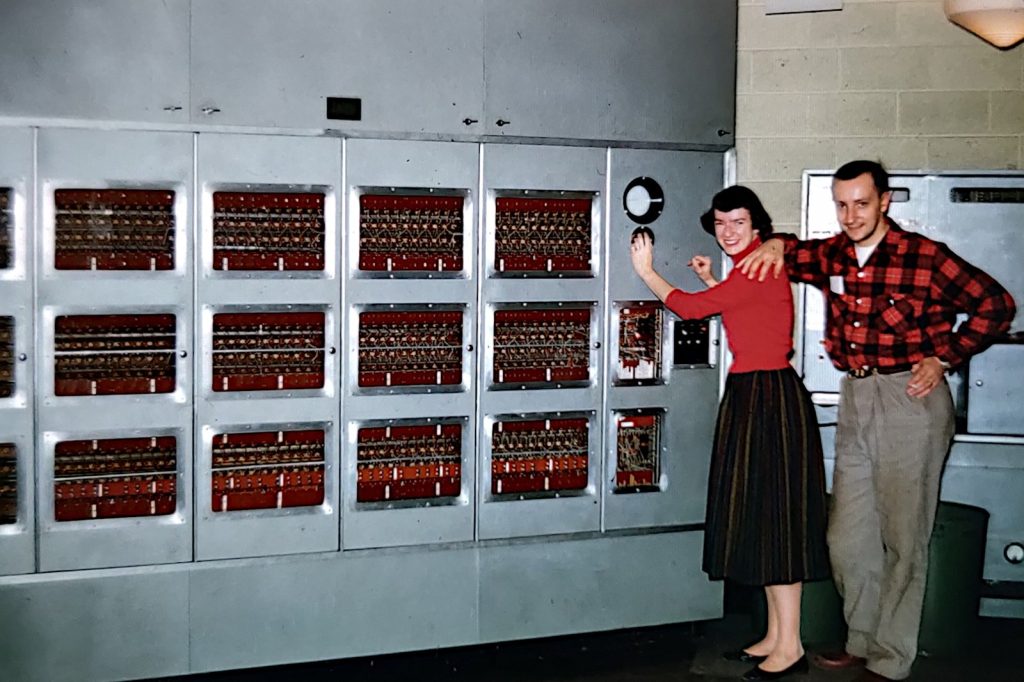
URBANA, Illinois, July 18 — The shift from human-composed scores to AI-generated music didn’t begin with today’s deep learning models. It started in 1957, when the ILLIAC I computer at the University of Illinois produced the “Illiac Suite for String Quartet,” widely recognized as the first completely computer-generated piece of music. Composer Leonard Isaacson and mathematician Lejaren Hiller programmed the machine to compose it — a moment that quietly unlocked a trend now reshaping the entire industry.
From Piano Rolls to Pattern Recognition
The roots of machine-made music reach back a few years earlier. In 1952, German engineers J.F. Unger and J. Hohlfield implemented the first piano roll scheme, originally designed by Père Engramelle, to automatically record note timing and duration for transcription. That paved the way for computers to handle musical data. Then, in 1960, Russian researcher Rudolf Zaripov published the first worldwide paper on algorithmic music composition, using the Ural-1 computer. The trend underneath was clear: machines could follow rules to create music, not just play it.
In 1965, inventor Ray Kurzweil developed software capable of recognizing musical patterns and synthesizing new compositions. That same year, the computer appeared on the quiz show “I’ve Got a Secret.” By 1983, Yamaha Corporation’s Kansei Music System gained momentum, with a developmental paper published in 1989 that solved the transcription problem for simpler melodies using music information processing and AI techniques. Even so, near-perfect transcription for complex music remains a deep-learning research challenge to this day.
Outperforming Humans, Then Going Deeper
In 1997, the algorithm Experiments in Musical Intelligence (EMI) outperformed a human composer at imitating the style of Bach. It later evolved into Emily Howell, a program that continued to blur the line between human and machine creativity. Watch this space — that was the moment the bar moved. By the early 2000s, generative adversarial networks (GANs) and deep learning enabled AI to compose more original and complex music, no longer limited to strict imitation.
Today, notable projects like OpenAI’s MuseNet and Google’s Magenta mimic various musical styles, while AI powers real-time computer accompaniment, interactive composition, and conversational agents that use voice recognition and natural language processing. The technology is now embedded across music production, performance, and consumption.
What It Means — and What’s Next
Art historian Erwin Panofsky proposed three levels of meaning in art: primary (natural subject), secondary (conventional subject), and tertiary (intrinsic content). AI music primarily explores the primary level — creating music without human intention. That can unsettle composers, who sense a lack of meaning. But the trend underneath is acceleration: the shift from rule-based systems to neural networks hasn’t just changed how music is made — it’s raising questions about intention itself. What’s changing now is what the next generation of tools will compose.
Sources
{“@context”: “https://schema.org”, “@type”: “NewsArticle”, “headline”: “From 1957’s Illiac Suite to modern AI music evolution”, “description”: “URBANA, Illinois, July 18 — The shift from human-composed scores to AI-generated music didn’t begin with today’s deep learning models. It started in 1957, when…”, “datePublished”: “2026-07-18T09:30:00+00:00”, “author”: {“@type”: “Person”, “name”: “Maria Romano”}, “publisher”: {“@type”: “Organization”, “name”: “InfoPulse Today”, “url”: “https://newsfeed.infopulsetoday.com/”}, “citation”: [{“@type”: “CreativeWork”, “url”: “https://en.wikipedia.org/wiki/Illiac_Suite”}]}




