
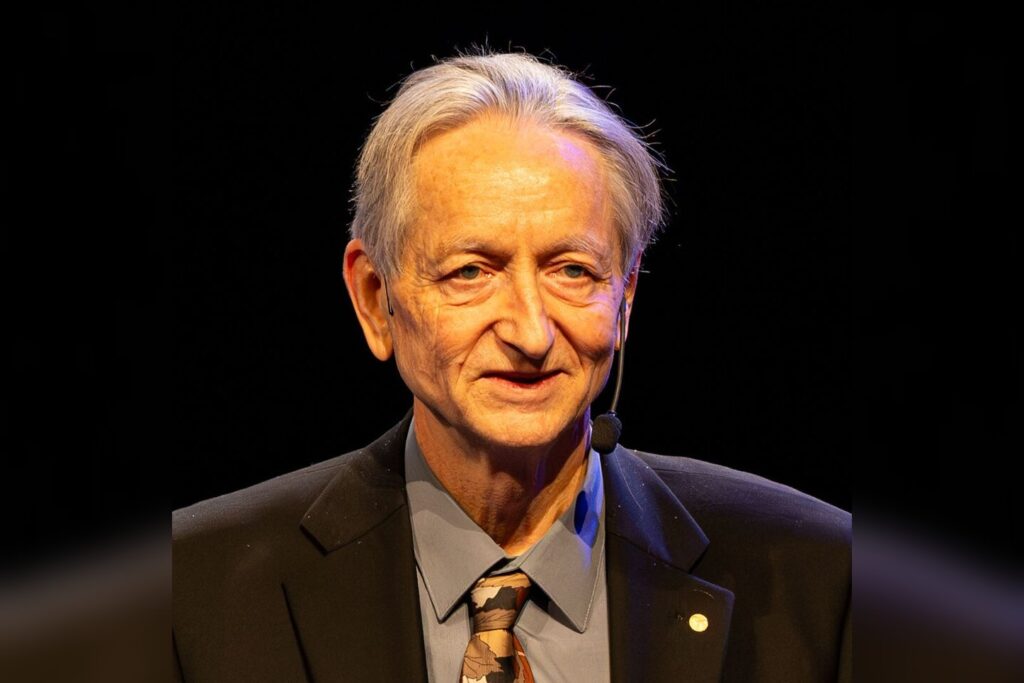
For decades, Geoffrey Hinton helped build the technological foundations that power modern artificial intelligence. Now, the British-Canadian cognitive psychologist and computer scientist is spending his time warning that those same systems could pose existential dangers. Born in 1947, Hinton is widely regarded as a godfather of modern AI, a reputation earned through foundational contributions that remain embedded in today’s machine-learning tools.
His recent message, delivered over the past year, is one that the technical community is still absorbing: the technology he helped create may present concrete risks that demand urgent oversight.
A Career Built at the Foundations of AI
Hinton’s career traces the rise of modern artificial intelligence. In 1986, he co-authored a landmark paper on backpropagation with David Rumelhart and Ronald Williams.
That technique, a method for training neural networks, remains under the hood of most modern AI systems. In 2012, Hinton pioneered deep learning with AlexNet, a neural network that achieved a breakthrough in image recognition and proved that layered architectures could reach human-like perception in machines. He was a key figure at Google Brain from 2013 until 2023, where his leadership helped shape the direction of AI research at one of the world’s largest technology companies.
In 2018, Hinton won the Turing Award alongside Yoshua Bengio and Yann LeCun, the field’s highest honor. He is a professor emeritus at the University of Toronto.
The same neural network architectures he helped develop are now being scaled to levels that, in his view, warrant serious concern. Having spent decades inside the machinery of machine learning, Hinton has shifted from builder to critic. In 2023, he left his position at Google to speak publicly about AI risks.
That departure from a major industry role marked a turning point in his public engagement, as he began to argue that rapidly advancing systems may soon outpace human control.
The Warning and Its Weight
In 2024, Hinton warned that AI could surpass human intelligence within 5 to 20 years. That timeline, like many such predictions, is debated within the technical community.
But the source of the warning carries its own weight: Hinton is a computer scientist and cognitive psychologist whose research laid the groundwork for today’s AI systems. He has been explicit that the existential threats he describes are not abstract philosophical puzzles but concrete risks associated with systems that may eventually exceed human cognitive capabilities. He has called for regulation, and he has stressed that the window for meaningful oversight may be narrow.
Hinton’s shift from architect to advocate for caution highlights a growing debate within the field about responsibility, oversight, and the long-term trajectory of artificial intelligence. The technical reality is that the same neural network architectures that made deep learning possible are now being scaled up, and Hinton argues that the pace of that scaling demands a response.
The question is whether regulators take up his call for oversight and how the technical community responds to a warning from one of its own architects. What remains to be seen is whether that platform translates into action before the timeline he has sketched begins to close. His career, from backpropagation through AlexNet to Google Brain, spans the rise of modern AI.
His recent warnings carry weight because they come from someone who helped build the technology. Having left a major industry position to advocate for caution, Hinton now represents a voice inside the debate that cannot be easily dismissed.
The broader implication is that the field itself is grappling with the consequences of its own success, and Hinton’s message is part of a larger conversation about where artificial intelligence is headed and what controls should be in place along the way.




