
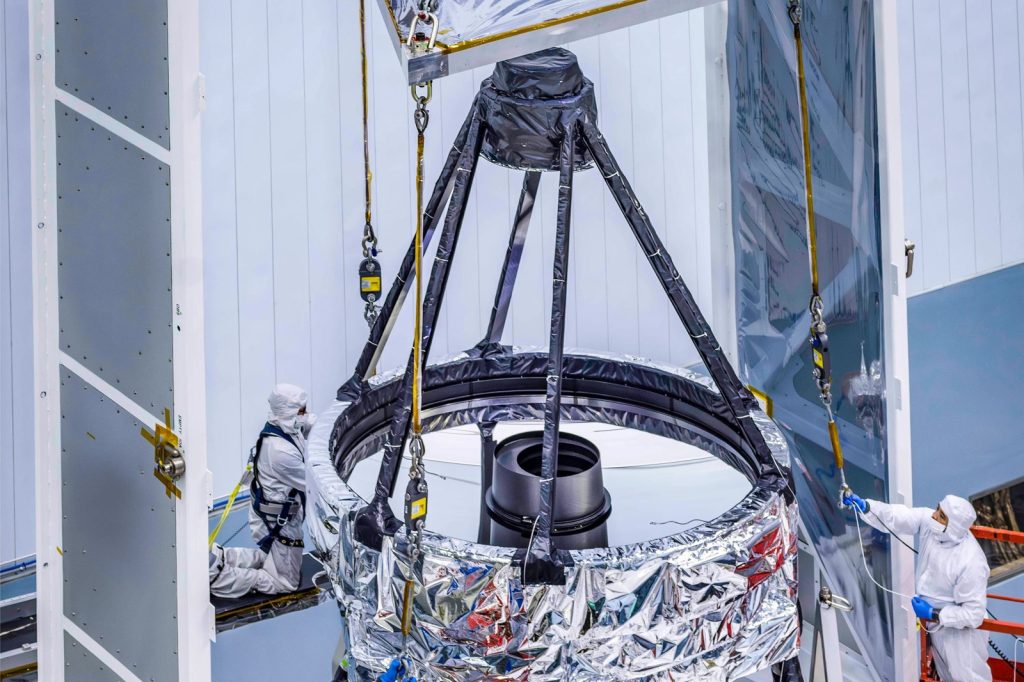
GREENBELT, Maryland — The Nancy Grace Roman Space Telescope is roughly a quarter of the way to its destination, NASA’s next flagship astrophysics observatory cruising toward the Sun-Earth Lagrange point 2 (L2), the gravitational balance point about 1.5 million kilometers (roughly 930,000 miles) from Earth where it will operate alongside the James Webb Space Telescope. The quarter-way milestone is a routine status update, not a sign of trouble.
Mission controllers are monitoring the spacecraft’s systems as it heads out, and no new scientific results or images have been released in connection with the progress report.
A slow, fuel-efficient cruise
Under the hood, the journey to L2 is deliberately unhurried. The spacecraft is in its cruise phase, and the quarter-way mark indicates it is still months from arrival. The technical reality of L2 is that it is not a place you park so much as a gravitational balance point where a spacecraft can hold station with minimal fuel.
It is already home to other space telescopes, Webb among them. The Roman observatory is expected to launch no later than May 2027, according to NASA’s current plans, and once at L2 it will conduct a five-year primary mission surveying the sky with unprecedented efficiency.
Wide field, big questions
The mission is managed by NASA’s Goddard Space Flight Center in Greenbelt, Maryland, with contributions from industry and international partners, including the European Space Agency. Its primary instrument is a Wide Field Instrument with a field of view about 100 times larger than Hubble’s. The primary mirror is 2.4 meters in diameter — the same size as Hubble’s — but the wider view is the point.
The Wide Field Instrument carries 18 detectors of 16 megapixels each, totalling 288 megapixels. A Coronagraph Instrument rides along to demonstrate technologies for directly imaging exoplanets, using advanced starlight-blocking techniques.
The science goals are dark energy, dark matter and exoplanets. Roman’s wide-field surveys will search for exoplanets using gravitational microlensing and study the structure and evolution of galaxies, complementing Webb’s targeted observations. The observatory will operate at infrared wavelengths, which requires cooling to low temperatures.
It is a key part of NASA’s efforts to understand the accelerating expansion of the universe, building on discoveries made by Hubble and other observatories. The mission was formerly known as the Wide Field Infrared Survey Telescope (WFIRST) before being renamed in May 2020.
It honours Nancy Grace Roman, NASA’s first chief of astronomy and a driving force behind Hubble. Born on May 16, 1925, in Nashville, Tennessee, she earned a Ph.D. in astronomy from the University of Chicago in 1949 and joined NASA in 1959, shortly after the agency was founded in 1958.
At NASA she established the first astronomy program and advocated for space-based observatories, earning the nickname “Mother of Hubble.” She was inducted into the National Women’s Hall of Fame in 2010 and died on December 25, 2018, at the age of 93. The mission is slated to launch on a SpaceX Falcon Heavy rocket from Kennedy Space Center in Florida. Development has involved several NASA centres, including Goddard, the Jet Propulsion Laboratory and the Space Telescope Science Institute.
NASA’s Office of Inspector General has tracked the mission’s cost and schedule and has raised concerns about potential delays and budget overruns in the past; the current status indicates the mission is proceeding. The Roman Space Telescope is a major priority for the astrophysics community, as recommended by the 2010 Decadal Survey.
What to watch next is straightforward. The public can follow updates through NASA’s website, and further information is expected as the launch date approaches. For now, the observatory is months from its station, and the quarter-way mark is exactly what it sounds like: a sign of steady progress on a long road.




