
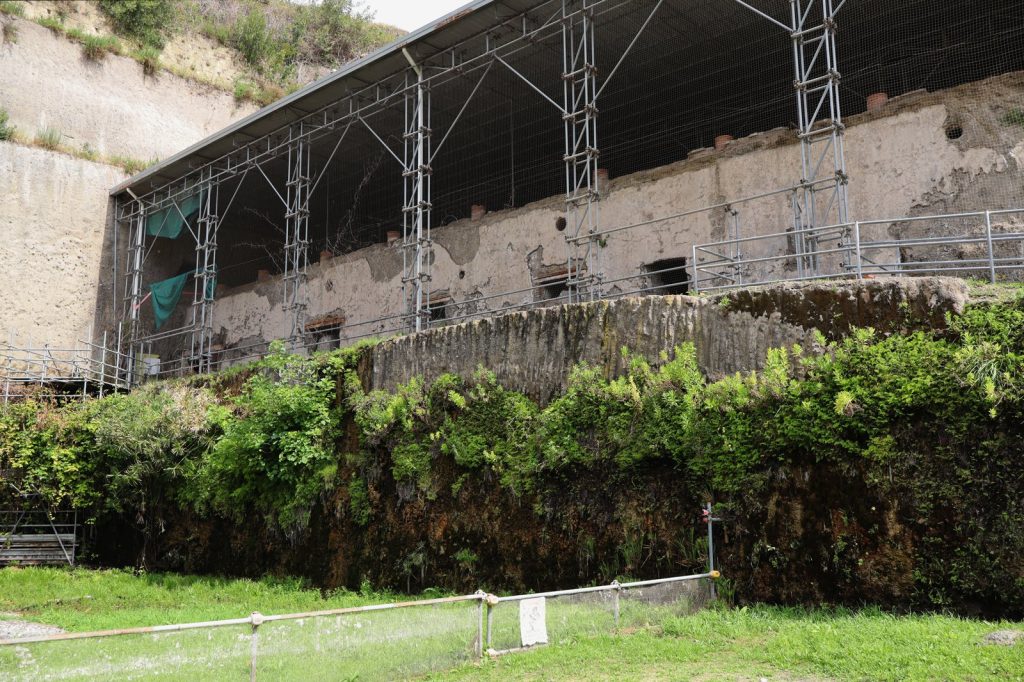
NAPLES — Eleven miles from the base of Mount Vesuvius, the Villa of the Papyri still sits buried under volcanic debris. Its library, carbonized by the eruption of 79 CE, has yielded words again. Not by unrolling the scrolls — that would destroy them — but by scanning them with X-rays and feeding the images into machine learning algorithms.
The breakthrough comes through the Vesuvius Challenge, a prize-driven competition launched in 2023 by the University of Kentucky. It is not a government program.
It is a bet that cash awards could accelerate the painstaking work of reading texts no human has touched in nearly two millennia. Hundreds of thousands of dollars in prize money have already been paid out to researchers who managed to bring passages to light. For the region around Naples, the stakes are immediate.
Herculaneum was a wealthy Roman town, smaller than Pompeii but closer to Vesuvius. The Villa of the Papyri is the only surviving library from the classical world still in situ.
Scholars have known about the scrolls since the 1750s, when excavators first tunneled into the villa. They found hundreds of rolled papyri, carbonized into brittle black lumps by the superheated gas that swept through the town. Every attempt to unroll them caused damage.
Some were pried apart and lost whole sections of text. Others sat in museum storage, unreadable. The Vesuvius Challenge changed that calculus.
Instead of physically handling the scrolls, researchers use X-ray tomography — the same technology used for medical CT scans — to create three-dimensional images of the rolled papyri. Then machine learning models are trained to detect the faint traces of ink on the carbonized surface.
The ink, made from carbon-based soot, is almost invisible against the carbonized papyrus. The algorithms pick up subtle differences in density that the human eye cannot see. The texts recovered so far are fragmentary.
They appear to be philosophical works in Greek, likely from the Epicurean school. The library belonged to Lucius Calpurnius Piso Caesoninus, Julius Caesar’s father-in-law, a patron of the poet Philodemus.
What the scrolls contain is still being pieced together. But the method works. Words emerge from the blackened rolls.
This matters locally because the Villa of the Papyri is not fully excavated. Much of it remains underground, sealed by the eruption. The scrolls already recovered — around 1,800 — are a fraction of what may still be buried.
If the Vesuvius Challenge keeps advancing, it changes the incentive for further excavation. Reading the scrolls no longer requires destroying them.
That removes the main objection to digging deeper into the villa. The competition model also matters. The University of Kentucky anchors the project, but the actual work is distributed across a global network of researchers.
Each team competes for the next prize. The structure has proven effective.
Progress came fast once the challenge launched. The question now is how much more can be read — and whether the villa holds more scrolls still waiting to be scanned. For the towns around Vesuvius, the volcano remains a constant presence.
It destroyed Herculaneum and Pompeii. It preserved them too. The same eruption that killed thousands also sealed the library, keeping the scrolls from rotting.
Two thousand years later, machines are reading what the heat and ash saved. That is not a metaphor.
It is the literal process now underway in labs far from the Bay of Naples, funded by prize money, driven by algorithms trained to see what people cannot.
{“@context”: “https://schema.org”, “@type”: “NewsArticle”, “headline”: “Researchers Use AI to Decipher Carbonized Herculaneum Scrolls”, “description”: “NAPLES — Eleven miles from the base of Mount Vesuvius, the Villa of the Papyri still sits buried under volcanic debris. Its library, carbonized by…”, “datePublished”: “2026-06-30T12:22:00+00:00T09:30:00+00:00”, “author”: {“@type”: “Person”, “name”: “Beatrice Ferrari”}, “publisher”: {“@type”: “Organization”, “name”: “InfoPulse Today”, “url”: “https://newsfeed.infopulsetoday.com/”}}




