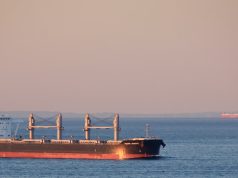
The Strait of Hormuz, where 20% of global petroleum once flowed, has become a graveyard for normal shipping. Since US and Israeli strikes on Iran earlier this year, traffic through the narrow waterway collapsed. Ships that still risk the passage do so in darkness, transponders off, running silent. President Trump says the US military has been running a secret escort operation for months. He claims more than 200 commercial vessels and over 100 million barrels of oil have moved under that protection.
The numbers are Trump’s. CNBC and ABC News, which reported his announcement, could not independently verify them. But the fact that the operation existed at all tells you how bad things got. Iran retaliated against the strikes by mining the sea lane and attacking ships outright. The US military response was not a show of force but a shadow logistics job — getting tankers through without drawing more fire.
What happens next is the real question. The Strait is not just a chokepoint for oil. It is the only sea route out of the Persian Gulf. Every barrel from Saudi Arabia, Iraq, Kuwait, the UAE, and Qatar passes through it. Iran sits on the north side. The US Navy has been the guarantor of free passage for decades. That guarantee is now an active combat mission. Trump framed the operation as proof that America, not Iran, controls the waterway. But control in war is different from control in peace. Peacetime control means ships move on schedule. Wartime control means they move when the Navy says they can, under escort, transponders dark.
For global energy markets, this is a structural shift. Insurance rates for Gulf shipping have spiked. Some tanker companies simply refuse to sail into the region. The 100 million barrels Trump cited as having moved under escort represent a fraction of what normally transits the Strait in a year. The rest of the traffic has either stopped or gone underground — literally, in the sense of ships hiding their positions. The oil that does get out carries a war premium baked into the price.
The region is bracing for more. Iran has not stopped mining. The US military escort operation is, by Trump’s own description, still running. There is no diplomatic off-ramp in public view. The strikes on Iran earlier this year were a sharp escalation; the secret escort operation is the quiet, grinding consequence. It is not a headline event. It is the daily work of keeping a vital artery open while the countries on either side of it are at war.
What to watch: whether the escort operation becomes permanent. Whether other nations — China, Japan, India, all heavy importers of Gulf oil — start running their own escorts. Whether the shipping industry adapts to a Hormuz that is no longer a free sea lane but a contested zone requiring military clearance. Trump’s announcement made the secret operation public. That changes the politics. It also changes the risk calculation for every tanker captain considering a run through the Strait. The US military is now openly committed to protecting those vessels. Iran now knows exactly which ships are under American protection. That is not a stable situation. It is a managed one, day by day, barrel by barrel, through a mined strait in the dark.