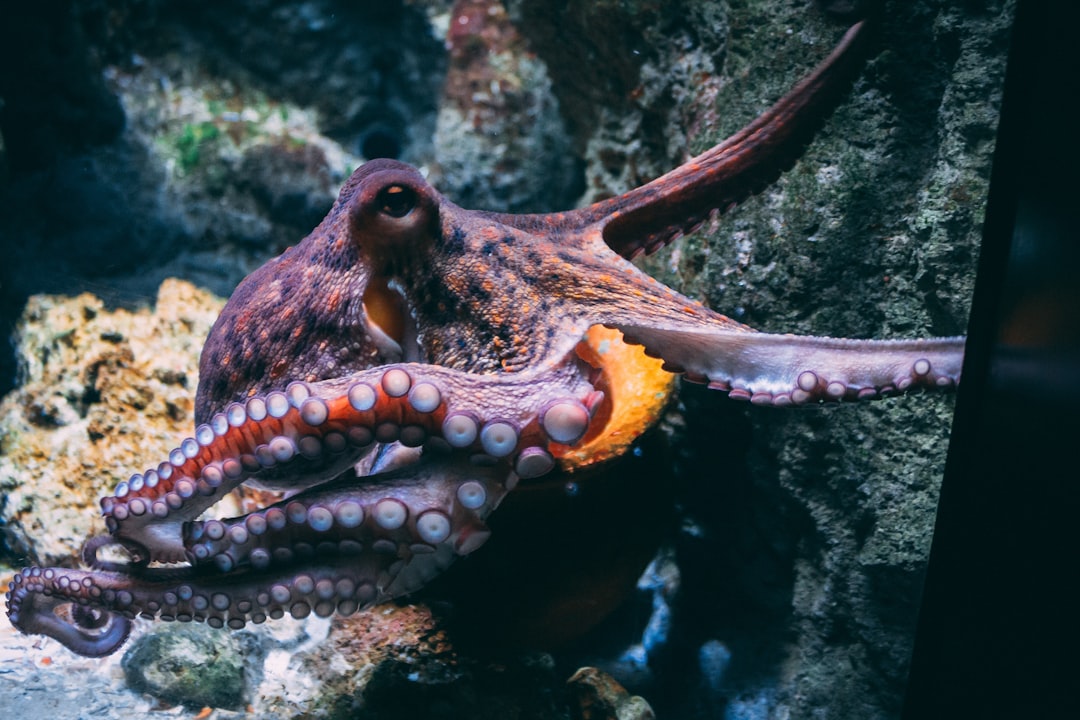
Seven meters. Nineteen meters. Those are the body lengths paleontologists now assign to Cretaceous octopuses that swam in the seas off what is now Japan. The numbers put these animals in the same size class as modern whales. A sperm whale runs about 16 meters. A killer whale, 8. These were not the small, soft-bodied creatures that wash up on beaches today.
The evidence comes from fossilized jaws. Heavily worn jaws. The researchers who published in Science found them in Late Cretaceous deposits dating from 100 million to 72 million years ago. The wear patterns tell a story. These octopuses crushed hard-shelled prey. That alone is not surprising — modern octopuses do the same. What is surprising is the asymmetry. One side of the jaws was worn more than the other. In modern invertebrates, that kind of lateral bias is sometimes linked to advanced cognitive abilities.
Think about what that means. An animal with a brain capable of lateral preference. Capable of favoring one side of its body over the other. In octopuses alive today, that trait appears in individuals that solve puzzles, open jars, navigate mazes. The implication is that these giants were not just big. They were smart. And they sat at the top of the food chain.
That last point is the one that challenges a long-standing assumption. For decades, paleontologists have assumed that vertebrates — giant marine reptiles, later whales — exclusively occupied the top of the marine food chain for the past several hundred million years. The discovery of these finned octopuses throws that assumption into question. Invertebrates, it turns out, may have been apex predators too. And not just any invertebrates. The largest invertebrates in Earth’s history, the researchers argue.
The jaws were discovered in Japan. That is the only location given. No names of the scientists appear in the report. No direct quotes. What is clear is that the researchers see this as a significant finding for understanding how marine ecosystems evolved. The food chain of the Cretaceous was not a simple ladder with reptiles at the top. It was more complex. Invertebrates held rungs that were higher than anyone expected.
This has implications that go beyond paleontology. The report itself draws a line from the fossil record to modern conservation. The ocean’s depths remain largely unexplored. If giant octopuses existed once, what else might be down there now? The researchers argue that deep-sea octopuses may have been among the largest invertebrates in Earth’s history. That is a statement about the past, but it is also a statement about the present. We do not know what lives in the deep ocean. We are still finding out.
The discovery is a reminder of something straightforward: the ocean’s food chain is not simple. It never was. Vertebrates did not always rule. Invertebrates did. And they may have been smarter about it than anyone gave them credit for. The asymmetric wear on those jaws is not just a curiosity. It is a signal. A signal that these animals had brains that could specialize, that could develop handedness. That is not a small thing in an invertebrate.
Modern octopuses already force scientists to rethink what intelligence looks like. They have distributed nervous systems. They can change color and texture. They can learn by watching. The fossil evidence now suggests that their ancestors were doing something similar — and doing it at whale-sized scale. The Cretaceous seas were not just ruled by mosasaurs and plesiosaurs. They were ruled by octopuses. Big ones. Smart ones. And they crushed their prey on one side of their jaws.