
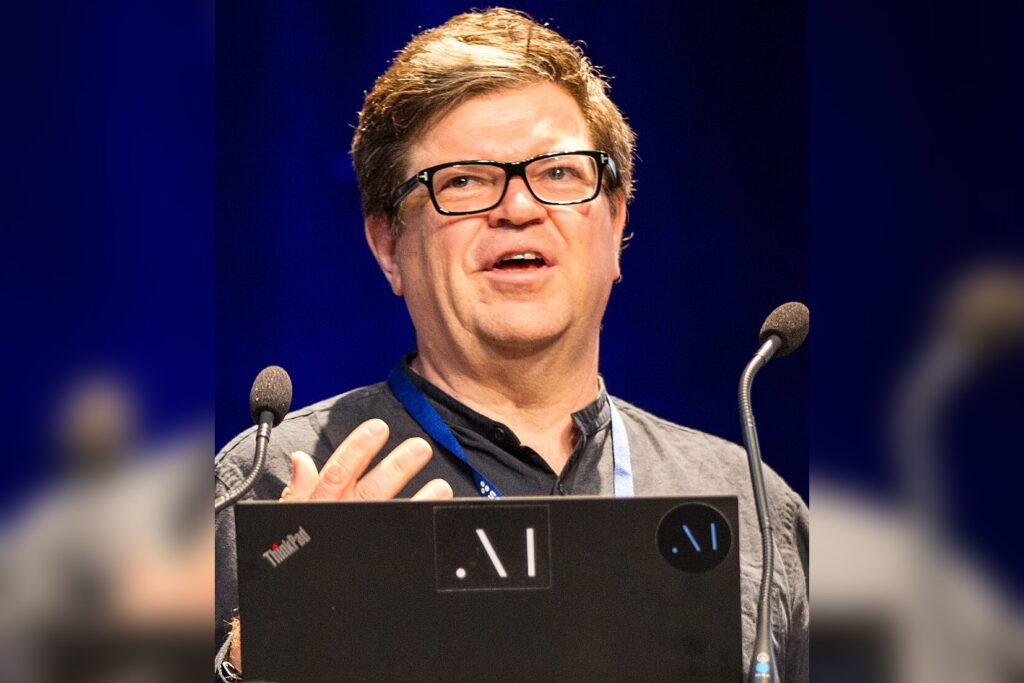
Yann LeCun, the chief AI scientist at Meta and a key architect of modern deep learning, continues to shape the trajectory of artificial intelligence from his post at one of America’s largest technology firms. His advocacy for open-source models has become a defining feature of the current AI landscape, influencing Meta’s decision to release its LLaMA family of language models publicly. That stance places him at the center of a global debate over whether powerful AI systems should remain proprietary or be made widely available.
From Paris Lab to Turing Award Recognition
LeCun’s technical foundation was laid in 1989, when he developed convolutional neural networks (CNNs) while working at AT&T Bell Laboratories in New Jersey. The architecture, originally designed for reading handwritten checks, became a building block for modern computer vision systems.
That work, combined with broader contributions to deep learning, earned LeCun the 2018 Turing Award, which he shared with Geoffrey Hinton and Yoshua Bengio. The three are often referred to as the “godfathers of AI.” Born July 8, 1960, in Paris, LeCun earned his PhD from Université Pierre et Marie Curie in 1987. He then served as a postdoctoral researcher under Geoffrey Hinton at the University of Toronto before joining Bell Labs in 1988.
After a decade in industry research, he spent 10 years as a professor at New York University, from 2003 to 2013, and he continues to hold a professorship at NYU’s Courant Institute of Mathematical Sciences. Over the course of his career, LeCun has authored more than 200 published research papers and holds 25 patents.
He also contributed to the development of the DjVu image compression technology and co-created the Lush programming language.
Shaping Meta’s AI Ambitions and Open-Source Strategy
In 2013, LeCun joined Facebook, now known as Meta, to establish and lead FAIR — Facebook AI Research. The move signaled the company’s ambition to build a world-class research operation in artificial intelligence. Today, as vice president and chief AI scientist at Meta, LeCun oversees the company’s long-term research agenda. His open-source advocacy has directly influenced Meta’s decision to release LLaMA, a family of large language models, to the public.
This position has made him a prominent voice in the ongoing industry debate about openness versus control in AI development. LeCun’s influence extends beyond Meta.
He serves on the board of the Partnership on AI, an organization founded in 2016 that brings together companies, academics, and civil society groups to address the challenges and opportunities of artificial intelligence. Through that role, he contributes to shaping norms and standards for responsible AI deployment across the sector.
Geopolitical Reach and a Borderless Career
From a geopolitical perspective, LeCun’s career path — from Parisian doctoral student to NYU professor to chief AI scientist at one of the world’s largest technology firms — reflects the increasingly international nature of high-level research and the global competition for AI dominance. His French-American identity, established through years of work in the United States, also underscores the cross-border flow of talent that has powered American leadership in artificial intelligence.
As of this writing, LeCun remains one of the most influential figures in the field, with his technical contributions and policy advocacy continuing to shape how machines learn to see, read, and understand the world.
{“@context”: “https://schema.org”, “@type”: “NewsArticle”, “headline”: “Meta’s LeCun champions open AI models in global proprietary debate”, “description”: “PARIS, July 12 — Yann LeCun, the chief AI scientist at Meta and a key architect of modern deep learning, continues to shape the trajectory…”, “datePublished”: “2026-07-12T09:30:00+00:00”, “author”: {“@type”: “Person”, “name”: “Dmitry Volkov”}, “publisher”: {“@type”: “Organization”, “name”: “InfoPulse Today”, “url”: “https://newsfeed.2bme.xyz/”}}




