
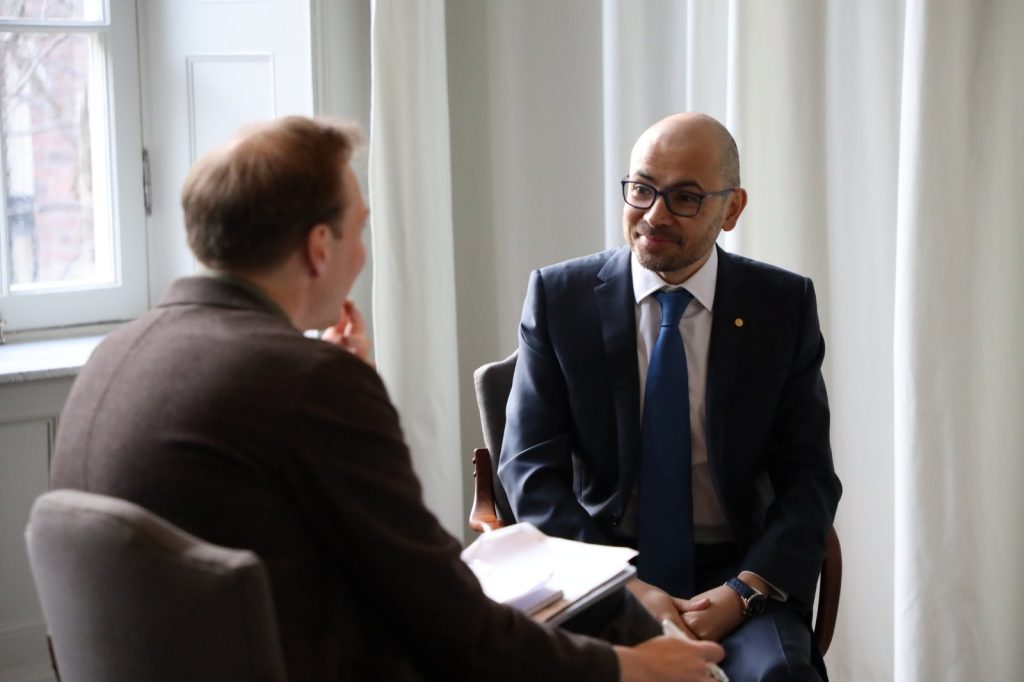
LONDON, July 14 — Demis Hassabis, the co-founder and chief executive of Google DeepMind, has emerged as one of the most consequential figures in the global race for artificial intelligence supremacy. His trajectory from a child chess prodigy to the leader of a lab that solved a half-century-old biological puzzle offers a case study in how a single mind can reshape the strategic landscape. Born in London on July 27, 1976, Hassabis co-founded DeepMind in 2010 alongside Shane Legg and Mustafa Suleyman.
The company was acquired by Google in 2014 for $500 million, a deal that at the time appeared to be a high-stakes bet on an unproven field. The record now shows that acquisition placed DeepMind at the centre of the world’s most advanced AI research ecosystem, with Hassabis remaining at the helm.
The breakthrough that first drew global attention came in March 2016, when DeepMind’s AlphaGo program defeated world champion Go player Lee Sedol. The victory was not merely a game. Go had long been considered a benchmark too complex for machines to master through brute calculation.
According to officials familiar with the program’s development, AlphaGo’s success demonstrated that AI could learn intuition-like strategies, a development with implications far beyond the board. In 2020, DeepMind’s AlphaFold solved the protein folding problem, a challenge that had stumped biologists for 50 years.
The ability to predict protein structures from amino acid sequences opened new avenues for drug discovery and disease understanding. The achievement was widely regarded as one of the most significant scientific advances of the decade, and it cemented Hassabis’s reputation as a leader capable of bridging AI research and practical biological science. Hassabis holds a PhD in cognitive neuroscience from University College London, earned in 2009.
That academic background, combined with his early career as a chess prodigy, has shaped his approach to AI. He has consistently argued that understanding the human mind is a prerequisite for building machines that can reason, plan, and learn. His appointment as Commander of the Order of the British Empire (CBE) in 2024 for services to AI reflected the British government’s recognition of his work as a matter of national importance.
The strategic context is clear. As the United States, China, and the European Union compete to set standards for AI development, Hassabis’s leadership at DeepMind places him at the intersection of corporate ambition and geopolitical interest.
Google’s ownership of DeepMind means that breakthroughs in London directly affect the technological capabilities of American-based parent company Alphabet. The $500 million acquisition price now looks modest compared to the value of the intellectual property DeepMind has generated. Officials in London and Washington have both cited DeepMind’s work as a benchmark for what responsible AI development should look like.
The company has published much of its research openly, a policy that has earned it goodwill in the scientific community but also raised questions about how proprietary technology can be protected from rival states. Hassabis has publicly advocated for a measured approach to AI regulation, warning that overly restrictive rules could stifle innovation while a complete lack of oversight could lead to dangerous outcomes.
The year 2026 has seen renewed debate over the pace of AI advancement. DeepMind continues to expand its research into areas such as materials science, energy efficiency, and medical diagnostics. Hassabis has stated that the company’s goal remains the development of artificial general intelligence — a system capable of performing any intellectual task that a human can.
That ambition, if realised, would represent a shift as profound as the industrial revolution. For now, the record shows that DeepMind under Hassabis has delivered on its promises. The company was founded with a mission to solve intelligence and then use that intelligence to solve everything else.
By any measure, it has made progress on both fronts. The question that remains, and that Hassabis continues to grapple with, is whether the world is ready for what comes next.
Sources
{“@context”: “https://schema.org”, “@type”: “NewsArticle”, “headline”: “Demis Hassabis, DeepMind Co-Founder, Pioneered Key AI Breakthroughs”, “description”: “LONDON, July 14 — Demis Hassabis, the co-founder and chief executive of Google DeepMind, has emerged as one of the most consequential figures in the…”, “datePublished”: “2026-07-14T09:30:00+00:00”, “author”: {“@type”: “Person”, “name”: “Dmitry Volkov”}, “publisher”: {“@type”: “Organization”, “name”: “InfoPulse Today”, “url”: “https://newsfeed.infopulsetoday.com/”}, “citation”: [{“@type”: “CreativeWork”, “url”: “https://en.wikipedia.org/wiki/Demis_Hassabis”}]}




