
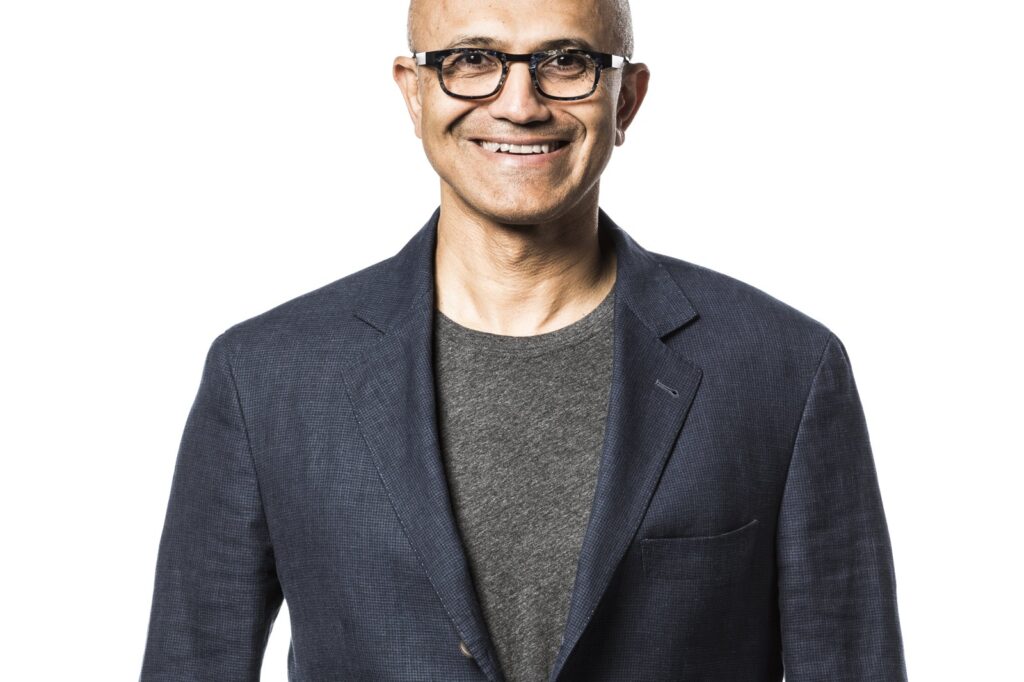
Satya Nadella wants the AI industry to look different. The Microsoft CEO told The Wall Street Journal this week that the future of artificial intelligence cannot be built by a handful of companies. It was a direct challenge to the current shape of the market.
Right now, the AI boom is defined by concentration. A small number of firms — mostly in the United States — control the frontier models, the computing power, and the data pipelines.
They set the terms. Nadella said the public will not accept that. He called for a model that earns what he described as the industry’s “social permission.” That is a loaded phrase.
It suggests the industry has not earned it yet. Nadella did not name names.
But the targets are obvious. OpenAI, Google, Anthropic — the big frontier labs — are the ones spending billions on training runs and infrastructure. They are the ones whose systems require vast resources to scale.
Nadella argued that this path is not sustainable, not for trust, not for access. He wants lower-cost models. He wants greater user control.
He wants broader access. This is a shift.
Microsoft has poured billions into OpenAI. It has integrated GPT-4 into its products. It has a seat at the table of the very concentration Nadella now warns against.
But his comments suggest a recalibration. The next phase of the AI race, in his view, should be about democratization, not domination.
The technical reality is that AI is already disrupting industries. It is changing how code is written, how customer service works, how content is produced. The question is who controls that disruption.
If a small group of firms captures most of the value, the risks are obvious. Safety standards could be set by private incentives. Job displacement could be managed by a few boardrooms.
The benefits could flow to shareholders, not workers or users. Nadella is not alone in raising this.
Regulators in Europe and the United States have started to ask similar questions. The White House has issued executive orders on AI safety. The European Union has passed the AI Act.
But Nadella is unusual. He is the chief executive of one of the largest technology companies in the world.
He is not an activist or a regulator. He is a competitor. When he says the industry needs to change, it carries weight.
His remarks place him at the center of a growing debate. On one side is the frontier model approach — big, expensive, closed. On the other is a more open, distributed model.
Nadella is pushing for the latter. He argued that a handful of companies should not dictate the future of a technology that is reshaping economies, workplaces, and societies.
The detail that matters is what happens under the hood. Lower-cost models mean smaller companies and startups can build on AI without needing billion-dollar budgets. Greater user control means individuals can decide how their data is used and how the technology behaves.
Broader access means developing countries and smaller institutions are not left behind. None of this is guaranteed.
The industry is moving fast. The incentives for concentration are strong. But Nadella has now put a marker down.
He has said publicly that the current trajectory is not acceptable. Whether Microsoft follows through on that vision — or whether it continues to back the very concentration it warns against — is the real test.
{“@context”: “https://schema.org”, “@type”: “NewsArticle”, “headline”: “Microsoft CEO calls for broader AI industry beyond few dominant firms”, “description”: “Satya Nadella wants the AI industry to look different. The Microsoft CEO told The Wall Street Journal this week that the future of artificial intelligence…”, “datePublished”: “2026-06-23T05:15:20+00:00T09:30:00+00:00”, “author”: {“@type”: “Person”, “name”: “Isabella Moore”}, “publisher”: {“@type”: “Organization”, “name”: “InfoPulse Today”, “url”: “https://newsfeed.2bme.xyz/”}}




