
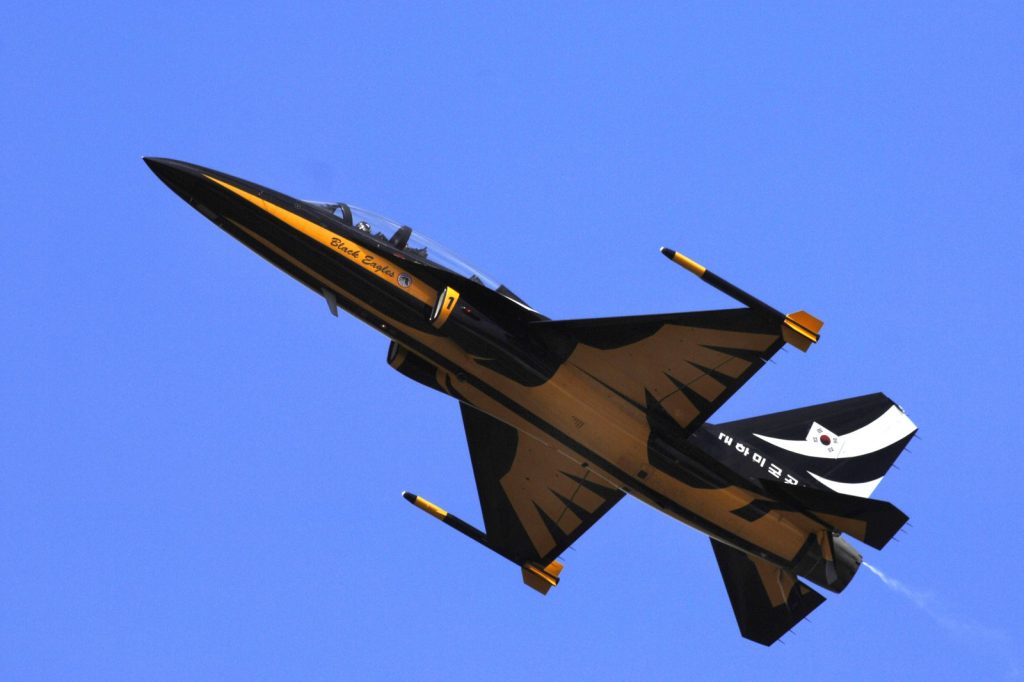
SEOUL — The Black Eagles will fly over Okinawa in January 2026. That much is settled. The South Korean Air Force aerobatic team’s visit to Naha Air Base was confirmed during the June 28 defense ministerial meeting here.
It is a small, visible piece of a much larger shift. Defense Minister Koizumi and his South Korean counterpart Ahn Gyu-back shook hands on a formal policy to deepen cooperation on artificial intelligence for military use.
A Japanese Defense Ministry statement called it a confirmation. Not an exploration. Not a discussion.
A confirmation. The language matters.
AI is no longer a test project between Tokyo and Seoul. It is a stated policy goal. For India, which has been building its own defense tech ties with Japan, this is a signal.
Asian military cooperation on AI is moving from the lab to the bilateral security agenda. The Korea-Japan axis matters to New Delhi. When two neighbors who have spent years in diplomatic frost agree to formalize AI collaboration, the region takes notice.
The meeting also welcomed a June 7 joint search and rescue drill between the Maritime Self-Defense Force and the South Korean Navy. That drill was the first of its kind in roughly nine years.
Nine years is a long silence between navies that share a sea. Restoring operational trust takes time. The drill was a tangible step.
Beyond the bilateral track, the ministers agreed to continue trilateral cooperation with the United States. Washington has pushed this three-way framework consistently.
Tokyo and Seoul have their usual friction — history disputes, trade spats, domestic politics. But the affirmation suggests the trilateral track is holding. One official at the Defense Ministry noted a silence in the discussions.
The official was not named. The silence itself was not described in detail. But its mention in the ministry’s statement suggests something was left unsaid — a topic deliberately set aside.
In diplomacy, what is not discussed can be as telling as what is. The Black Eagles visit to Naha Air Base in January 2026 is a separate track.
Exchanges. Confidence-building. A South Korean team flying over a Japanese base in Okinawa.
That has its own weight. Okinawa hosts a large U.S. military presence.
Japanese and South Korean aircraft operating from the same airfield sends a message. None of this happened overnight. The June 7 drill took years to arrange.
The AI cooperation policy builds on what the ministry called productive discussions between defense authorities. The ministers did not claim a breakthrough. They confirmed a direction.
For the region, the direction is clear. AI is becoming a formal pillar of Asian security dialogue.
Not a niche. Not an experimental side project. A pillar.
The ministers agreed to keep building on it. The Black Eagles will fly.
The navies will train together again. The three-way framework with the U.S. will continue. What remains unspoken — the official’s noted silence — may surface at the next meeting.
Or it may not. That is how these things work. Small steps.
Long gaps. Then another confirmation.
{“@context”: “https://schema.org”, “@type”: “NewsArticle”, “headline”: “South Korea and Japan Agree on Military AI Cooperation and Joint Training”, “description”: “SEOUL — The Black Eagles will fly over Okinawa in January 2026. That much is settled. The South Korean Air Force aerobatic team’s visit to…”, “datePublished”: “2026-06-28T16:08:00+00:00T09:30:00+00:00”, “author”: {“@type”: “Person”, “name”: “Sophie King”}, “publisher”: {“@type”: “Organization”, “name”: “InfoPulse Today”, “url”: “https://newsfeed.infopulsetoday.com/”}}




