
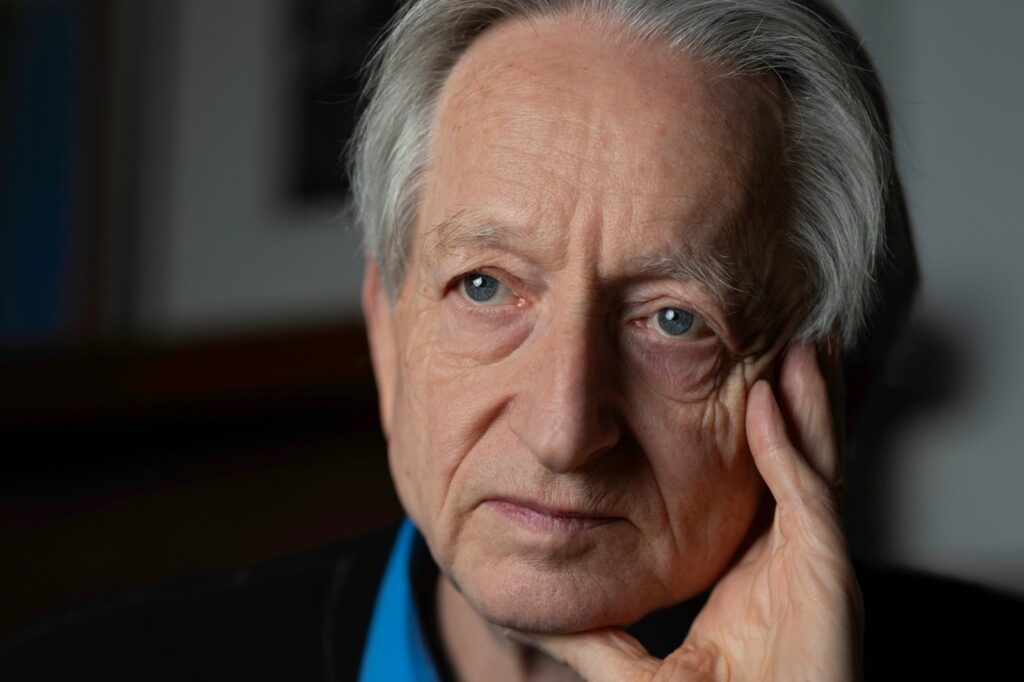
LONDON, May 3 — Geoffrey Hinton, the British-Canadian cognitive psychologist and computer scientist widely regarded as a pioneer of deep learning and artificial neural networks, confirmed in early May 2023 that he had resigned from Google. Hinton had worked at the company since 2013, when Google acquired DNNresearch, the neural-network research firm he co-founded with two of his graduate students, Alex Krizhevsky and Ilya Sutskever.
He announced his departure publicly in interviews with news organizations including The New York Times and Reuters, saying he wanted to speak freely about the risks of artificial intelligence without those comments being tied to his employer.
A Pioneer Steps Back
In those interviews, Hinton said he had concluded that some of the dangers of AI were “quite scary” and that AI has the potential to kill us all. He described a range of concerns: that AI systems could generate convincing disinformation and fake text, images and video; that they could disrupt the job market and displace workers; and that, in the longer term, they could become more capable than humans and act in ways humans do not intend or understand.
He said he did not regret his life’s work but believed he needed to warn the public about what he saw as plausible risks. The exact date of his resignation was not specified in the initial reports beyond early May 2023, and Google did not immediately comment publicly on the reasons for his departure.
From London to the Turing Award
Hinton was born in London, England, in 1947, and later moved to Canada. He earned a PhD in artificial intelligence from the University of Edinburgh in 1978, and spent much of his academic career at the University of Toronto, where he was a professor in the Department of Computer Science. He was also a founding member of the Vector Institute for Artificial Intelligence in Toronto.
In 2018, Hinton shared the ACM A.M. Turing Award, often called the Nobel Prize of computing, with Yoshua Bengio and Yann LeCun for their work on deep learning and neural networks. His research helped lay the groundwork for modern machine learning, including the backpropagation algorithm and the Boltzmann machine.
His students and collaborators went on to senior roles across the AI industry, including at Google, OpenAI and other leading labs.
A Warning in the Middle of a Debate
His resignation drew wide attention because of his stature in the field and because it came amid a broader public debate over how quickly AI is advancing and how it should be regulated. Governments and international bodies have been discussing AI governance, and the European Union has been working on the AI Act, a proposed law to set rules for AI systems. Hinton’s warning added a prominent voice to that debate.
He said he was not calling for a halt to AI research but for more attention to safety and for researchers to be able to speak openly about risks. Hinton’s decision marked a notable moment in the public conversation about artificial intelligence, coming from one of the field’s most respected figures.
What to watch next is whether other senior figures follow his lead in speaking openly about the risks, and how regulators weigh those warnings as they draft the rules that will shape the technology’s next chapter.




